Geneva, 12 May 2026
As urbanization accelerates and cities face growing challenges, global leaders have called on governments, mayors, and the private sector to unlock the transformative power of artificial intelligence (AI) and digital innovation to shape the future of human living in cities and beyond.
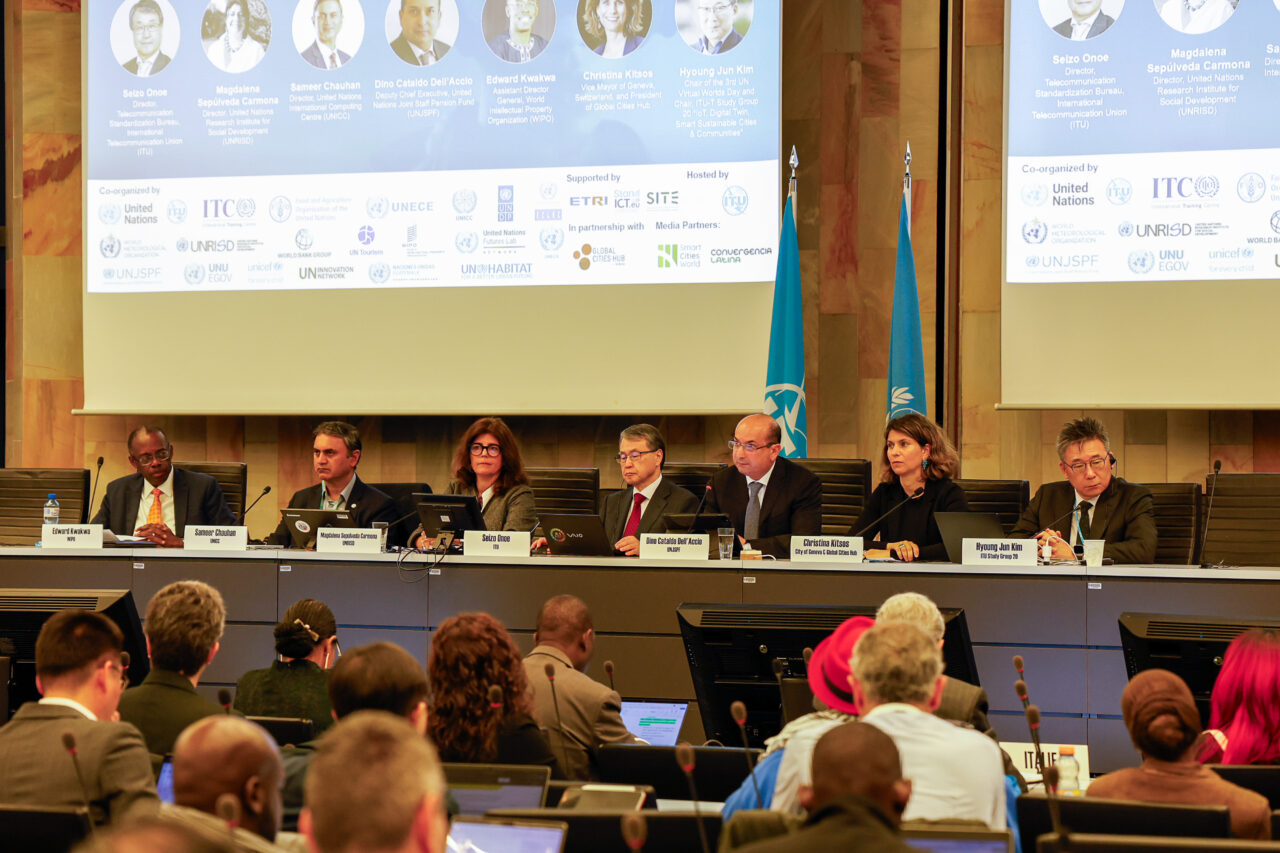
The message was at the heart of events for the 3rd UN Virtual Worlds Day, held on 11–12 May at the International Telecommunication Union (ITU) in Geneva, Switzerland, co-organized with the support of UNICC and 19 other UN entities.
With 70 per cent of the world’s population projected to live in urban areas by 2050, the UN event focused on opportunities presented by the “AI-enabled citiverse” – a digital ecosystem combining AI, spatial intelligence, digital twins, and immersive technologies to enhance urban planning, decision-making, and quality of life.
“Innovation is advancing rapidly. Interoperability, trust, and integration are not advancing at the same pace. Technology alone will not define the future. Collaboration and trust will.”
Sameer Chauhan, Director, UNICC
Reimagining life in cities and beyond
Recognizing that decisions made in cities today will define the future of urban life, participants issued Call to Action for Humanity: Shaping the Future of Cities in the Age of AI and Citiverse.
The Call to Action identifies five strategic priorities:
- Delivering global commitments locally
- Building trusted and inclusive AI systems
- Improving decision-making through data and simulation
- Enabling responsible economic and social growth
- Strengthening international cooperation and standards.
“We are entering a new era: AI systems interacting with the physical world, infrastructure becoming intelligent, and decisions informed by real-time data. This is the foundation of inclusive communities that are more efficient, resilient, and responsive to all inhabitants,” conference participants said in the Call to Action.
From vision to action
The UN partners also released an Executive Briefing on Artificial Intelligence, Spatial Intelligence, and the AI-Enabled Citiverse, providing practical guidance for ministers, regulators, and city leaders to navigate the next phase of urban digital transformation.
The briefing warns of urgent challenges requiring global coordinated action, including governance, data, and interoperability gaps, trust and safety concerns, institutional readiness, digital fragmentation, and the digital, rural, and gender divides collectively known as the “triple divide.”
Both the Call to Action and the Executive Briefing emphasize that the benefits of AI and the citiverse must reach all communities, including developing economies and underserved populations.
Over 400 participants representing the technology industry, governments, and urban administrations joined the two-day meeting.
The outcomes of the conference will be submitted as input to the World Urban Forum 13 and the UN Forum of Mayors 2026.
About UN Virtual Worlds Day 2026
The 3rd UN Virtual Worlds Day was co-organized by ITU together with ITCILO, FAO, UNDP, UNECA, UNECE, UNECLAC, UN Guatemala, UN-Habitat, UNICC, UNICEF, the UN Innovation Network, UNJSPF, UNRISD, UN Tourism, UNU-EGOV, the UN Futures Lab, the World Bank Group, WIPO, and WMO, in partnership with the Global Cities Hub.
Resources
- Call to Action: https://www.itu.int/epublications/en/publication/call-to-action-for-humanity-shaping-the-future-of-cities-in-the-age-of-ai-and-citiverse/en
- Executive Briefing: https://www.itu.int/epublications/en/publication/executive-briefing-ai-spatial-intelligence-and-the-ai-enabled-citiverse
- Full programme: https://www.itu.int/un-virtual-worlds-day/2026/